

Expert energy insights, company updates,
and practical tips to keep your home comfortable year round.
Emergency AC Repair in Connecticut: What to Do When Your AC Stops Working?
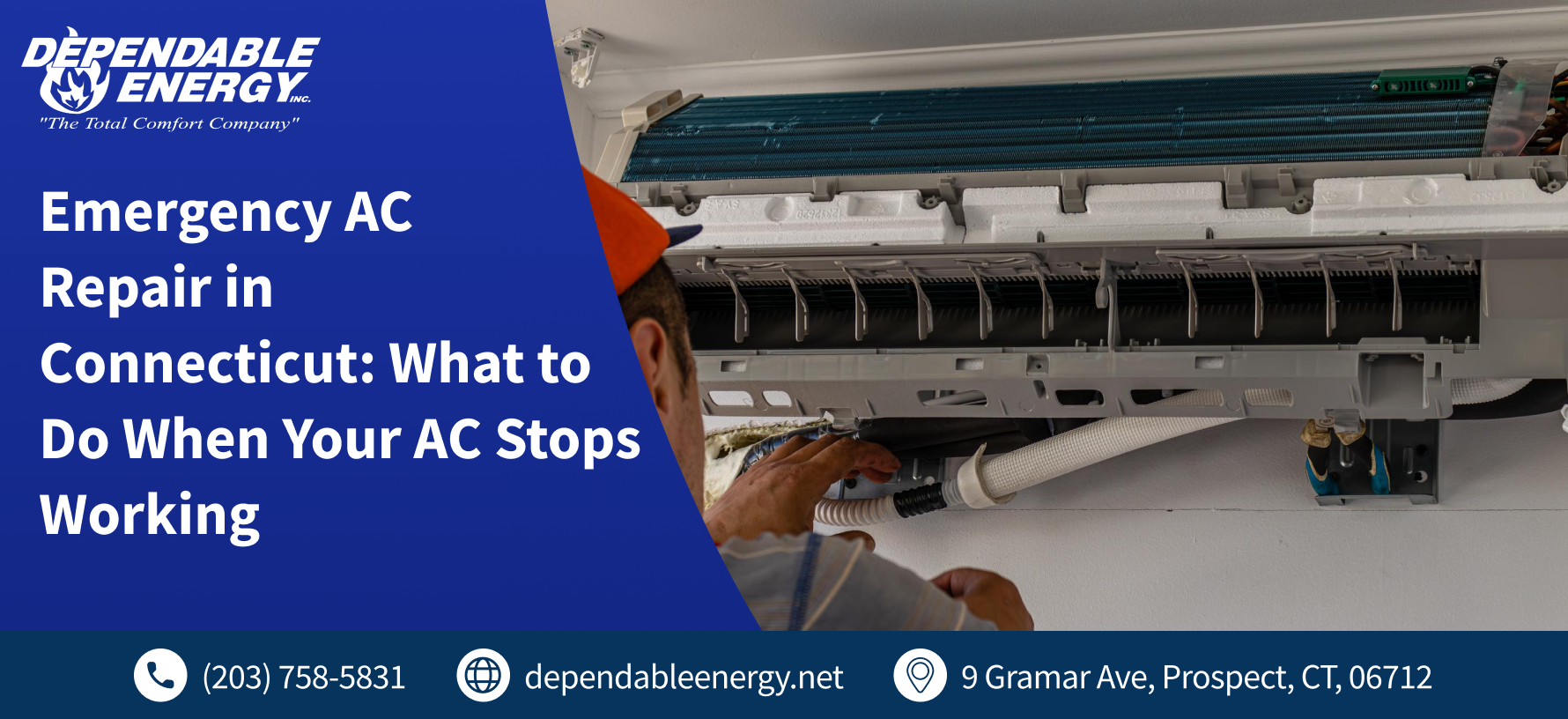
It’s 92 degrees outside. The humidity is sitting at 80%. You walk in from work, reach for the thermostat, and realize: nothing’s happening. No cool air. No hum of the outdoor unit. Your AC has stopped working.
This is one of the most frustrating things that can happen to a Connecticut homeowner in July or August — and unfortunately, it happens at the worst possible times. HVAC systems don’t tend to fail on a mild spring day. They fail when they’re working hardest: during heat waves, when every HVAC company in the state is also fielding emergency calls.
Here’s what to do when your AC stops working — from the first things to check before you call anyone, to how to stay comfortable while you wait for a technician.
Step 1: Check the Obvious Things First
Before calling for emergency service, run through this quick checklist. A surprising number of ‘AC failures’ are resolved without a technician.
Check your thermostat
Make sure the thermostat is set to ‘Cool’ (not ‘Fan’ or ‘Heat’), the temperature is set below the current room temperature, and the batteries aren’t dead. It sounds basic, but dead thermostat batteries are a real and surprisingly common cause of apparent AC failure.
Check your circuit breakers
Go to your electrical panel and look for any tripped breakers — they’ll be in the middle position (not fully on or off). Your AC system typically has two breakers: one for the outdoor unit and one for the air handler or furnace. Reset any tripped breakers by turning them fully off, then back on. If a breaker trips again immediately after being reset, stop and call a technician — a repeatedly tripping breaker indicates a real electrical problem that needs professional attention.
Check the air filter
A severely clogged air filter can cause the evaporator coil to freeze over, which blocks airflow and makes the system stop cooling even when it’s technically running. Pull your filter out and hold it up to the light. If you can’t see light through it, it’s overdue for replacement. Replace the filter, turn the system off for 1–2 hours to let any ice melt, then turn it back on.
Check the condensate drain line
Most AC systems have a float switch in the drain pan that shuts the system off if the condensate drain line becomes clogged. A clogged drain is one of the most common causes of AC shutdowns. Look for a small PVC pipe near your indoor air handler — if you see standing water in the drain pan, that’s likely your issue. A technician can clear the line quickly.
Check the outdoor unit
Go outside and look at your condenser unit. Is it running? Is the fan spinning? Is there ice on the refrigerant lines going into your home? If the unit is iced over, the system likely has a refrigerant or airflow issue. If the unit isn’t running at all and the breaker is on, you may have a failed capacitor or contactor — both are common, affordable repairs.
Step 2: When to Call for Emergency AC Repair?
If you’ve run through the checklist above and the system still isn’t working — or if you’ve found a problem that isn’t a simple filter swap or thermostat issue — it’s time to call a professional.
Call right away if you observe any of the following:
- The outdoor unit is making grinding, squealing, or banging sounds
- You smell burning or detect an electrical odor from the air handler or outdoor unit
- There’s visible ice on the outdoor unit or refrigerant lines and the system runs continuously
- The circuit breaker trips repeatedly after being reset
- The system is running but producing warm air and the outdoor unit sounds normal
- There’s standing water around the air handler or signs of a refrigerant leak (hissing sound, oily residue on refrigerant lines)
These situations won’t resolve on their own and can lead to more expensive damage if left running. Shut the system off and call a licensed technician.
Step 3: How to Stay Cool While You Wait?
Depending on the time of day and how busy HVAC companies are, you may be waiting a few hours to a few days for service. Here’s how to manage in the meantime — especially important for households with elderly residents, young children, or pets.
Focus cooling on the rooms you’re actually using
Close off rooms you don’t need to cool and focus on keeping one or two spaces comfortable. Close blinds and curtains on south- and west-facing windows during daylight hours to block solar heat gain.
Use fans strategically
Ceiling fans and portable fans don’t lower air temperature, but they create a wind chill effect that makes you feel cooler. Run ceiling fans counterclockwise in summer to push cool air down. Place a box fan in a window facing outward in the evening to exhaust warm air when the outdoor temperature drops below indoor temperature.
Reduce indoor heat sources
Avoid using the oven or cooking on the stovetop. Use a microwave, grill outside, or eat cold foods. Minimize use of lights and electronics that generate heat. Do laundry and dishwasher loads in the early morning or late evening.
Know the warning signs of heat illness
Heat exhaustion and heat stroke are serious medical conditions. Watch for heavy sweating, weakness, cold or pale skin, dizziness, nausea, or headache (heat exhaustion) — or hot dry skin, confusion, rapid pulse, or loss of consciousness (heat stroke, which is a medical emergency). If anyone in your home shows signs of heat stroke, call 911 immediately.
Consider a temporary cooling option
If you’ll be waiting more than a day and temperatures are extreme, a portable air conditioner or window unit from a home improvement store can provide relief for one room. Hotels and libraries also offer air-conditioned environments if needed.
What to Expect During an Emergency AC Repair Visit?
When a technician arrives, they’ll diagnose the problem before recommending repairs. Common emergency AC repairs include:
- Capacitor replacement — capacitors help start the compressor and fan motor. They fail regularly and are usually an affordable, quick repair.
- Contactor replacement — the contactor is an electrical switch that controls the outdoor unit. When it fails, the unit won’t start. Also an affordable, common repair.
- Refrigerant recharge — low refrigerant (from a leak) reduces cooling capacity and eventually stops the system from cooling altogether. Note that simply recharging refrigerant without finding and fixing the leak is a temporary fix — the technician should identify the leak location.
- Capacitor or motor replacement on the air handler — if the indoor blower isn’t moving air, the system can’t cool your home effectively.
- Condensate drain clearing — as mentioned above, a clogged drain is common and quick to resolve.
Before approving any repair, ask the technician to explain what failed and why, what the repair costs (parts and labor), and whether the repair is a permanent fix or a temporary solution. A reputable technician will give you clear answers.
When a Repair Isn’t Worth It?
Emergency repairs are sometimes the beginning of a larger conversation about whether to repair or replace an aging system. If your system is 12 or more years old and is facing a costly repair, replacement may be the smarter financial decision — even if the timing feels inconvenient.
A good technician will give you both options and the information you need to decide without pressure. If you’re only being told to repair a system that’s clearly near the end of its life, get a second opinion.
When your AC breaks down in a Connecticut heat wave, Dependable Energy is here to help. We serve Greater Waterbury and surrounding communities with experienced, licensed technicians who will diagnose the problem honestly and fix it right. Call (203) 758-5831 or visit dependableenergy.net. We’ve been keeping Connecticut homes comfortable since 1946.
Frequently Asked Questions
Q: How long does emergency AC repair usually take?
A: It depends on what failed and parts availability. Many common repairs — capacitor replacement, contactor, condensate drain clearing — can be completed in under an hour. If a part needs to be ordered, there may be a delay. A technician will give you a realistic timeline after diagnosing the issue.
Q: My AC is running but not cooling. What’s going on?
A: This is usually a refrigerant issue, a frozen evaporator coil, or a problem with the compressor. Start by checking your air filter — if it’s severely clogged, replace it and let the system sit off for an hour or two. If the problem continues, call a technician. Running your AC when it’s low on refrigerant can damage the compressor, which is one of the most expensive components to replace.
Q: Can I just add refrigerant myself?
A: No. Refrigerant handling requires EPA certification under Section 608 of the Clean Air Act. Purchasing and handling refrigerants without certification is illegal. Beyond the legal issue, simply adding refrigerant without diagnosing and fixing the leak is ineffective — you’ll be back in the same situation in weeks or months.
Q: How can I prevent emergency AC breakdowns in the future?
A: Annual preventive maintenance — typically done in spring before cooling season — is the most effective way to catch problems before they become emergencies. During a tune-up, a technician will check refrigerant levels, clean the coil, test electrical components, check the capacitor and contactor, and clear the condensate drain. Most of the common causes of summer AC failures are detectable during a routine maintenance visit.
Q: At what outdoor temperature is it dangerous to be without AC?
A: The risk depends on indoor temperature, humidity, and who’s in the home. Elderly adults, young children, and people with certain medical conditions are vulnerable at temperatures most healthy adults find tolerable. In general, indoor temperatures above 85–90°F are a health concern for vulnerable populations. If you have elderly family members, infants, or people with heart or respiratory conditions in your home, don’t wait out a multi-day AC outage — find a cooler environment.
Search Articles
Categories
Contact Us Today
For more information about our services, call us at (203) 758-5831 or complete the form.
What Happens After I Send My Message?
- Our team will review your information.
- A staff member will contact you as soon as possible.
- We will work with you to schedule your service.
Our Sister Companies